Green driving with AdBlue
Modern campers use AdBlue technology to meet the latest legal environmental standards. Diesel engines with a Euro 6d-temp certificate have significantly lower emissions thanks to AdBlue. But: what exactly is this magic potion?
AdBlue is a liquid consisting of demineralized water with 32.5 percent urea. This liquid is injected into the exhaust system during driving, between the diesel engine and the catalytic converter. This creates a chemical reaction in which the toxic nitrogen oxide – NOx – from the exhaust gases is converted into much less harmful water vapor and nitrogen.
Diesel cleaner than petrol
AdBlue reduces NOx emissions by 85 percent. As a result, a modern diesel engine even emits less nitrogen oxide than the same car with a petrol engine. In this way, nitrogen oxide emissions are minimized, and the particulate filter reduces soot particles to an absolute minimum. This makes modern diesel engines cleaner than petrol engines, which is supported by various scientific studies. This technology has been applied in trucks since 2006, and AdBlue was introduced in the passenger car industry from 2014.

Modern campers with a Euro 6d-temp diesel engine are now also equipped with AdBlue technology. They have a separate tank on board for this that needs to be refilled regularly. In Fiat, Citroën, and Peugeot models, you will find the blue AdBlue cap under the fuel tank cap. In the Mercedes Sprinter, the cap is under the hood. To see how AdBlue works in practice, we compare a camper based on the Mercedes Sprinter with one based on the Fiat Ducato.
Mercedes more economical than Fiat
Campers that use the Mercedes Sprinter as a base vehicle have a 22-liter AdBlue tank on board. For campers based on the Fiat Ducato, this is a 15-liter tank. Research by the German magazine Promobil shows that the Mercedes Sprinter uses approximately 2 percent AdBlue per liter of diesel. For the Fiat Ducato, this is double: 4 percent.
These percentages are consistent with our experiences. With a Fiat, you will therefore have to refuel AdBlue more often, also because the AdBlue tank is only 15 liters. So you will be at the pump more often than with a Mercedes-based camper, and this is also evident in practice: during our experiences with a Hymer BMC semi-integrated, we received a signal after 7,000 kilometers that we had to refill AdBlue. You then have more than 2,000 kilometers to find a pump.

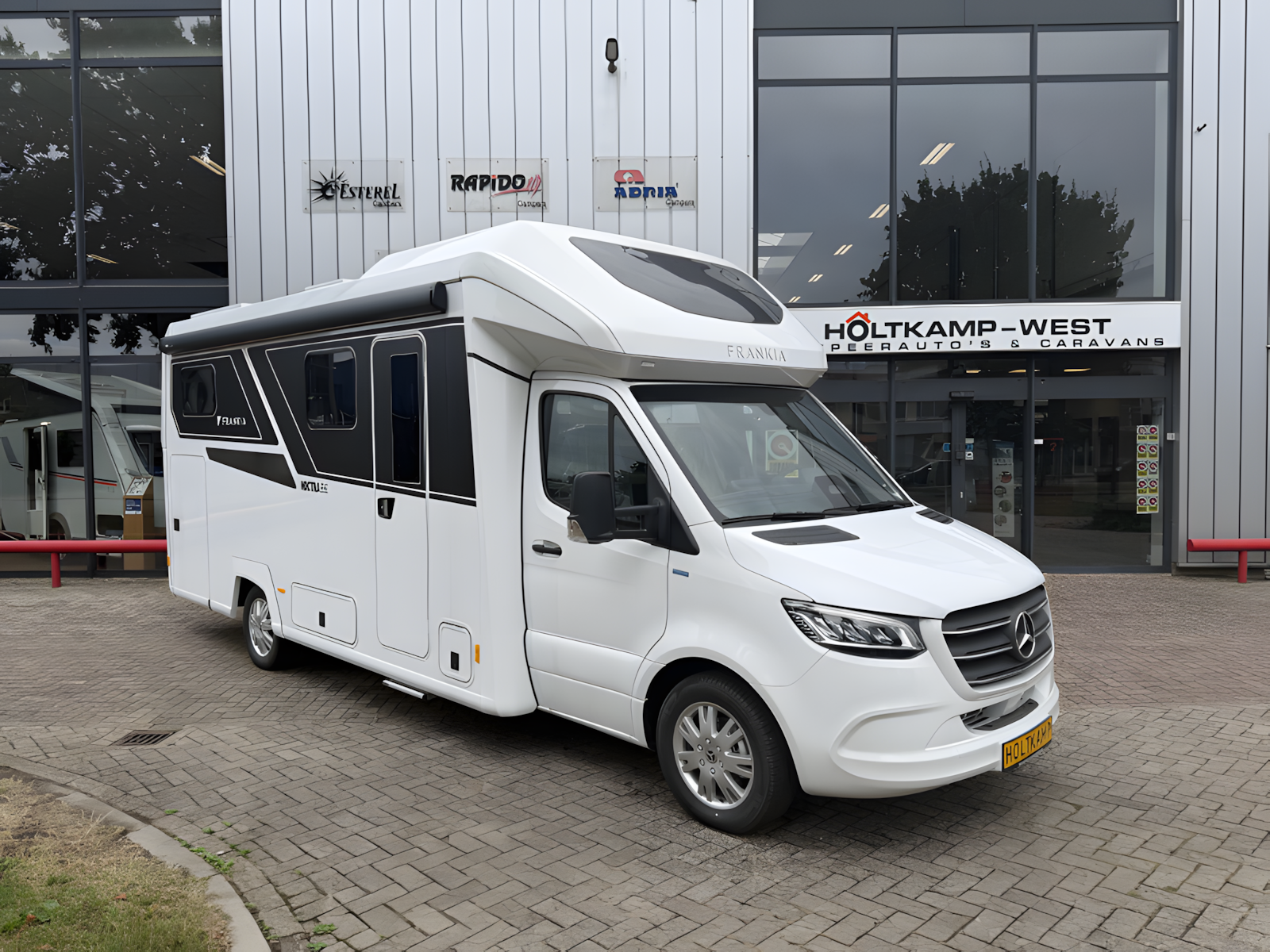
With a Frankia with the Fiat Ducato as the base vehicle, a signal came after barely 2000 kilometers that the AdBlue supply needed to be refilled. Due to both the higher consumption and the smaller tank, you have a range of about 3,000 kilometers compared to 9,000 with Mercedes. Another advantage of Mercedes is that you always see how much AdBlue you still have. This is while with the Fiat, you have to rely blindly on the messages the system gives that you need to refill.
Jerrycan or at the pump
AdBlue is available at almost every gas station. At least: in plastic jerrycans. But then you pay the top price, because in Germany we have already paid – converted – 3 euros per liter in that way, while at the pump it costs about 65 cents per liter. Usually, you then have to go to the larger gas stations along the highway, where you then have to join the trucks. Just like for fuel, the cheapest way to refuel AdBlue is at gas stations that are not on the highway. This is because refueling along the highway is simply much more expensive.
A useful website to find gas stations is www.findadblue.com which also has an app for your smartphone.
Large selection
Still looking for a new camper or caravan? We have a wide selection where you can choose from dealers and private individuals. Or would you rather first check out the latest Camping news?