Comfortable camping without hassle: how to create a relaxation spot at your camper or caravan
Why a good outdoor seating area makes all the difference
Anyone who ever slides open the motorhome door after a long drive knows the moment: you want to stretch your legs, your head wants to rest and you have zero desire for another job. Yet it is often precisely then that the "relaxation place" outside turns out to be another project. Unfolding chairs, securing table legs, looking for cushions, and just as you finally sit, the surface appears skewed or a pine cone pricks your back.
A comfortable outdoor seating area is more than just comfort. It's the start of your holiday feeling. Land with a cup of coffee, children who immediately kick their shoes off in the grass, and you who finally look around you. It also helps practically: if you sit well outside, you live more spaciously, the camper remains uncluttered and the caravan feels "full" less quickly.
Start with the basics: subsoil, shade and walking routes
Most irritation is not caused by your chair, but by what happens around it. Place your seat in a spot where you naturally end up: close enough to the door for convenience, but not in the path of everyone entering and exiting. Also consider the swinging door, the kitchen hatch, or the spot where you dry a wet dog after a forest walk.
Substrate is the silent spoiler. Grass is soft, but can become soggy. Gravel is stable, but uncomfortable for bare feet. Sand feels like a holiday, until you find it everywhere in your cup and bag. A compact ground sheet or sturdy mat can solve a lot, especially if you like to stand in different places and don't want to improvise every time.
Shade is your comfort insurance. In the morning, a spot in the sun is lovely, but around lunchtime, you often want to be able to retreat. An awning, tarp, or parasol ensures that your seating area remains usable all day. Also, pay attention to wind: by the sea or in an open field, a “nice spot” can suddenly become a drafty hole.
What works better than classic camping chairs?
Camping chairs come in all shapes and sizes, but they share one common challenge: they almost always require multiple actions. Unfolding, adjusting, adding a cushion, adding a footrest, and then putting everything back again. Anyone who makes frequent short stops or likes to spontaneously sit outside will find that this threshold quickly becomes too high.
Alternatives that score well in practice are lightweight loungers, compact floor cushions with a sturdy base, and solutions that are quickly ready without having to empty half your storage space first. The secret lies in reducing “friction”: the fewer steps, the more often you actually use it. A couple I once spoke to at a campsite in Zeeland put it beautifully: “We have the perfect chairs, but we too often leave them behind because it's a hassle.” That's a clear hint that the perfect chair should not only be comfortable but also inviting to grab.
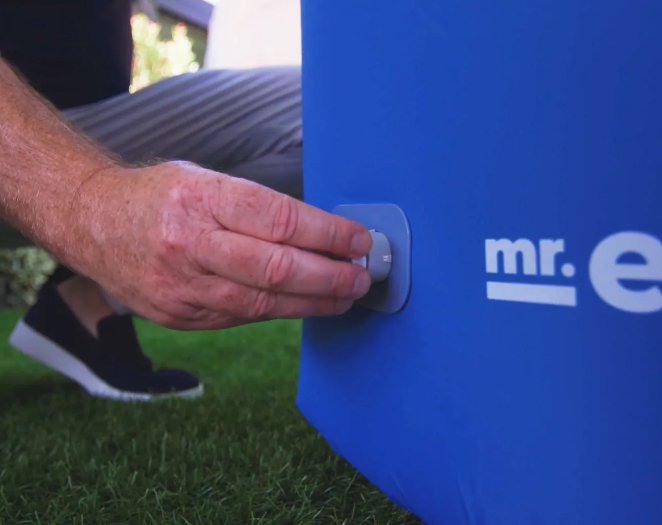
In that list, you'll also find solutions that become ready for use in a short time, such as Mr. E-ZY which you regularly see among campers because you quickly create a relaxation spot without having to bring a separate pump.
Making your packing list smart: comfort without extra baggage
Comfort often sounds like “more stuff,” but smart camping is about being selective. Rather choose one seating solution that you truly love to use, than three mediocre options that take up space. Think in terms of functions: do you want to read, have long dinners, or mainly lie down after a walk? A chair that isn't quite comfortable will make you move indoors anyway.
Pay attention to weight and volume, especially with camper vans or if you bring bikes, leveling blocks, and an outdoor table. A handy test: can you grab your seat in one go without moving five other items first? If not, chances are it will be left “for later.”
Also consider maintenance. Everything you use outdoors will encounter dust, moisture, sunburn, pine needles, and sometimes an unexpected rain shower. Materials that are easy to wipe clean and dry quickly provide peace of mind. This also applies to the accessories around them: a throw that can withstand a splash, a cup that won't tip over on uneven grass, and a small, sealable container for loose items like a book, earbuds, and chargers.
Make it cozy without it becoming frumpy
Cozy doesn't have to mean building a complete outdoor living room. It's often in small, practical choices. A warm battery-powered light ensures you don't immediately disappear inside when dusk falls. A soft underlay beneath your feet makes you stay seated longer. And a fixed spot for “outdoor items” prevents you from having to search every time.
Also try working with a fixed setup that you can set up in minutes. For example: seating area to the left of the door, small table next to it, lamp in a hook on the awning, and a basket with essentials. After a few days, it will become second nature and it will feel like you can immediately feel at home wherever you are.
Anyone camping with children will notice that a relaxation spot is also a “buffer zone”. While they're still doing a round on the scooter, you're close enough to watch, but comfortable enough not to get restless. And if you're traveling as a couple, it's the place where you review the day, make plans, and sometimes just stay silent because the view does the work.
Practical checks for your next trip
Test at home, not just at the campsite
Place your seating solution in the garden or on a balcony once. How quickly can everything be set up? How does it feel after twenty minutes? And how easy is it to pack away again? This small test prevents you from discovering on the road that something was only theoretically convenient.
Think about micro-comfort: neck, feet, and warmth
A small pillow, a light blanket, and something to rest your feet on often make more difference than a larger piece of furniture. Even in summer, evenings cool down faster than you think. If you're just comfortable, you'll stay outside longer and the spot will feel like a real vacation corner.
Make tidying up as easy as setting up
The best relaxation spot is one that you can easily pack away when you're about to drive or when the wind picks up. Use designated bags, clear spots, and as few loose parts as possible. Then comfort won't be an extra chore, but a natural part of your camping routine.