Importing a camper from abroad? First calculate the BPM
More and more camper owners are looking across the border for their next motorhome. The offer in Germany and Belgium is large and prices are often lower than in the Netherlands. However, the purchase price is not the only thing you should pay attention to. When importing a camper, you pay BPM, and that amount largely determines whether your foreign find ultimately turns out to be truly advantageous. Those who calculate this properly in advance will not be faced with surprises afterwards.
What is BPM and why do you pay it on a camper?
BPM stands for tax on passenger cars and motorcycles. This tax does not exist abroad, so as soon as you bring a vehicle to the Netherlands, you must file a BPM declaration. This also applies to campers, and even if the amount to be paid is ultimately zero euros. The declaration always precedes registration with the RDW. Only when the declaration is complete can your motorhome get a Dutch license plate and you can drive it on the road.
The amount depends on the type of camper
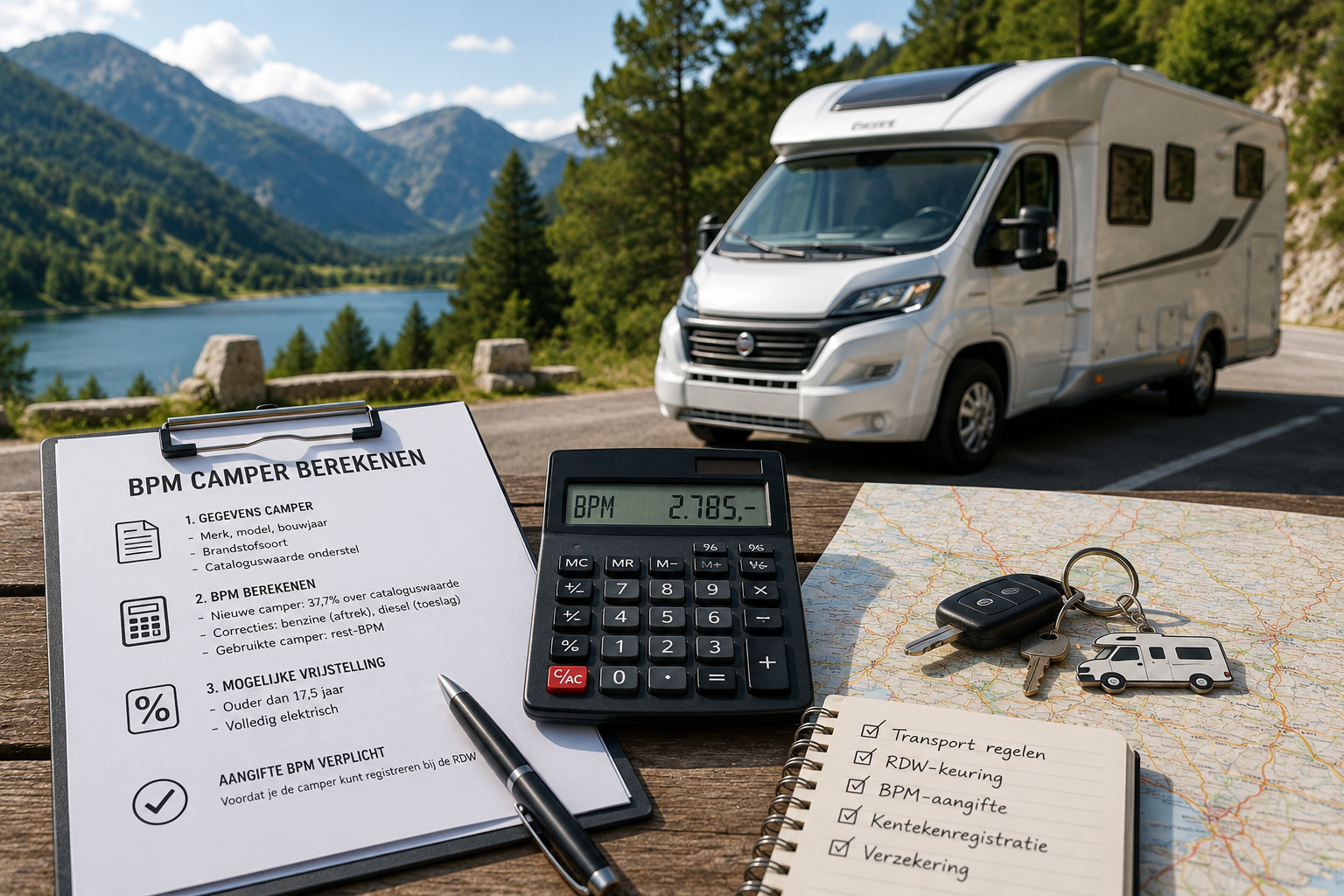
There is no fixed amount that applies to every camper. For a new camper, the BPM is calculated on the net catalog value of the chassis, i.e. the original new price excluding VAT and BPM. The standard rate is 37.7% of that catalog price. If the camper runs on petrol, a deduction of more than a thousand euros applies. With a diesel engine, a small surcharge is added. So your purchase price is not leading, but the factory price of the chassis.
For a used camper, you do not pay full BPM, but a so-called residual BPM. This is based on the depreciation since the first registration abroad. This is often where the biggest difference lies between paying too much and paying just enough. An older camper with significant depreciation can turn out to be much more favorable than you might initially think.
Two ways to determine the residual BPM
You can determine the residual BPM in two ways. The first is the flat-rate depreciation table: easy to apply, but usually less favorable. The second is a calculation based on the current market value, substantiated with an appraisal. The second route often turns out to be more advantageous for older campers. Which method is best depends on the age, the catalog value, the current market value, any conversion construction and the type of fuel.
Anyone who makes the wrong choice here runs the risk of a higher assessment or even an additional assessment afterwards. Therefore, have your calculate camper BPM by a party that compares all permitted methods and looks for the lowest possible outcome.
Pay attention to possible exemption
In a number of situations, you do not have to pay any BPM at all. This applies, for example, to a camper that is older than 17.5 years and to a fully electric motorhome. Even then, the declaration remains mandatory, only the amount to be paid will be zero euros. It is therefore good to check in advance whether your camper falls under such a scheme, because that saves considerably on the total costs.
Also pay attention to the conversion construction
Many motorhomes are first imported as a delivery van and then converted into a camper. In that case, you can assume the original catalog value of the delivery van for the BPM. This can make a significant difference in the final calculation. The condition is that the conversion meets the requirements for a motorhome and is correctly registered with the RDW. By looking at the type of chassis and the design in advance, you can influence the costs yourself. It is therefore worthwhile to carefully review the model, year of manufacture and construction before making a choice.
Why calculating in advance pays off
The BPM is only part of the total cost. In addition, you have to deal with transport, the RDW inspection, license plate costs and any appraisal costs. By mapping all this out in advance, you know exactly whether the camper from Germany or Belgium is still more advantageous after all costs than a comparable model in the Netherlands. A calculation in advance gives you that certainty and prevents you from making a decision based solely on the asking price.
This is how you do it
If you have a camper in mind, collect the most important data: the brand and model, the year of manufacture, the type of fuel and the link to the advertisement. With this information, an import specialist can calculate the lowest possible BPM for you, often within one working day. This way you know your financial situation before the purchase and you can cross the border with peace of mind for your next camping adventure.