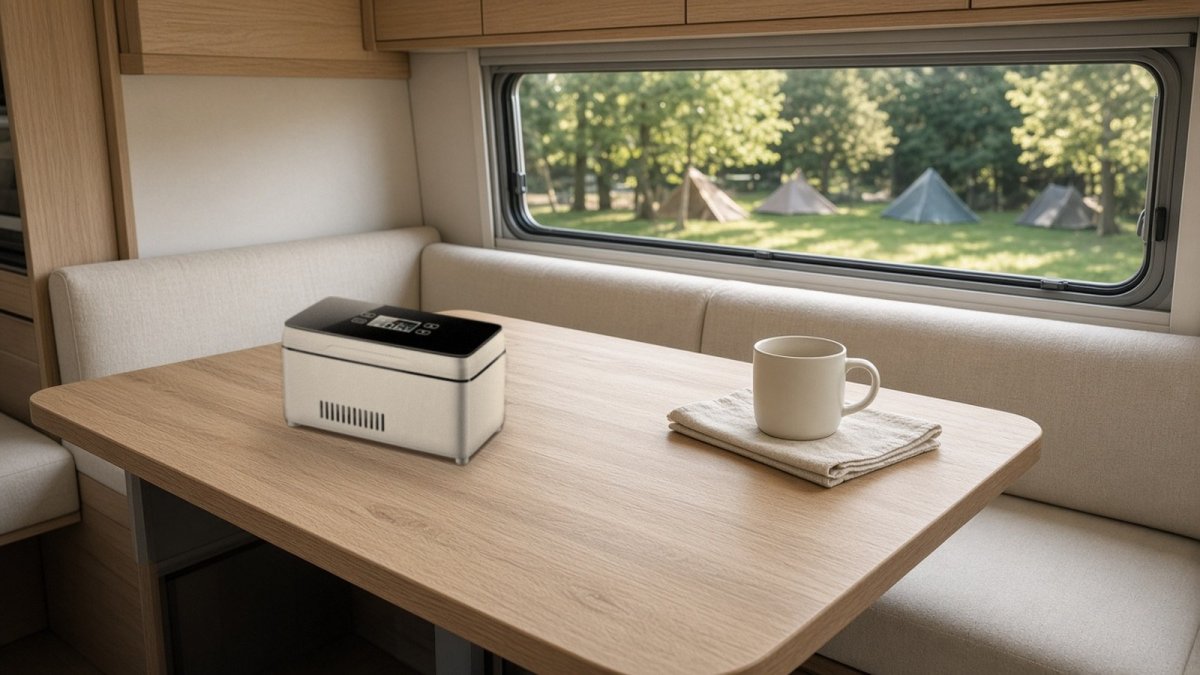
Keeping medication cool on a motorhome trip: here's how to do it
Anyone going on the road with a Motorhome or Caravan thinks about the route, the campsites, and whether the bikes are securely fastened. Medication is rarely at the top of the list, even though it is the most important piece of luggage for many travelers. Insulin, certain injection pens, eye drops, or liquid antibiotics often need to stay within a specific temperature range. And a Motorhome is precisely not always the easiest place for this: the sun shines on the roof all day, the power sometimes comes from the battery and sometimes from the campsite, and the refrigerator behaves differently than the one at home.
Below you can read how to practically deal with it, from preparation at home to the last day at the campsite.
Start with the leaflet, not with the cool box
The first step is to know what your medicine actually needs. This differs per agent. Some medicines must remain unopened between 2 and 8 °C, but may be kept at room temperature for a while after opening. Others can simply be kept in the cupboard, as long as it does not get too warm.
Therefore, read the package insert carefully and ask your pharmacist if in doubt. Also mention how long you will be away and to what climate.
The motorhome refrigerator: convenient, but not always stable
Many Motorhomes and Caravans have an absorption refrigerator that runs on 230 volts, 12 volts, or gas. Fine for butter and drinks, but less predictable for medication. At high outdoor temperatures, such a refrigerator often fails to reach the set temperature, and on 12 volts, it usually only cools while driving. If you are stationary on a warm day without a connection and without gas, the temperature inside will slowly rise.
A compressor refrigerator cools more stably, but even there the back wall is sometimes very cold and the temperature fluctuates in the door. Therefore, never place medicines against the freezer compartment or the cold back wall, nor in the door compartment. A spot in the middle, in a box or bag, usually works best.
What almost everyone forgets: measuring. A simple min-max thermometer in the refrigerator shows what happened during your absence. This way, you can also see if it suddenly became 14 degrees Celsius in the afternoon.
Summer heat and the spots to avoid
A parked Motorhome in the sun becomes an oven within an hour. The dashboard, the cabin, and the cupboards on the sunny side are the hottest spots. The garage at the back can also heat up considerably.
A few habits that help:
- Store medicines that do not require cooling on the shady side, low in the motorhome, where it stays coolest.
- Take medicines on day trips instead of leaving them behind.
- Laat niets in de auto of op de scooter liggen tijdens een terrasje “van tien minuten”.
Power on the go: 12V, USB and mains power
How you keep medicines cool depends heavily on the power supply you have available. At the campsite, you usually have mains electricity, although in many countries you will need a CEE adapter plug or a long cable. On the road, everything runs on the leisure battery or the starter battery.
A separate cooler that runs on 12 volts or USB is therefore a welcome addition for many motorhome owners. You can connect it to the cigarette lighter while driving, to a USB port of the leisure battery or to a power bank when you go for a walk. An active Medicine cooler with a display, the contents are kept at a set temperature and it shows what is happening, which is nice with variable power sources. A regular cool bag with ice packs can also be used, but it only slows down the warming process; for a long, hot day, that is often too tight.
Please pay attention to your battery capacity. A refrigerator, a cooler, phones, and a laptop add up quickly. If you are camping off-grid a lot, roughly calculate the consumption in advance.
Abroad
If you travel abroad, there will be some paperwork. Ask your pharmacy for an English-language medication overview or medication passport. For some medications, a special declaration is required to take them with you; your pharmacist or the CAK can tell you if that applies to you. Take medications in their original packaging with the pharmacy label.
Take plenty with you, preferably a little more than you think you'll need. A delayed ferry or an extra week in the sun is more the rule than the exception on a motorhome trip, and not every medication is readily available abroad.
First fly, then rent a motorhome
If you fly to, for example, Norway or New Zealand to rent a motorhome there, extra rules apply. Medicines should be in your hand luggage, never in the checked baggage: it can get very cold in the hold and a suitcase can get lost. Bring a medical certificate for security, especially with needles or liquids over 100 ml.
If you use a cooler with a battery or a power bank, check the rules of your airline in advance. Loose lithium batteries are usually only allowed in hand luggage, and there is a maximum capacity.
When picking up the rental motorhome, it is worth checking immediately what kind of refrigerator it has, whether there is a 12V or USB connection, and where it stays coolest in the motorhome.
Checklist for departure
- Storage instructions checked in the leaflet or at the pharmacy
- Sufficient medication, plus a reserve
- English-language medication overview and any certificates
- Min-max thermometer for the refrigerator or cooler
- Cooler or cool bag with the appropriate plug (12V, USB, 230V)
- Power bank and charging cables for day trips
- CEE adapter plug for foreign campsites
- If flying: medication and cooler in hand luggage
Finally
Keeping medication cool on a motorhome trip is not a difficult task, but it does require some preparation. Those who know what medication they need, keep an eye on the temperature, and avoid the warmest spots in the motorhome, can focus again on what matters: driving, looking around, and sitting outside with a chair in the evening. If you have any doubts, call your pharmacy before you leave. That will save you a lot of worries on the road.