How to keep a pressure washer at full power for years
A pressure washer is one of the most versatile pieces of equipment in the professional cleaning world. Whether it's for facades, patios, vehicles, or industrial installations, the machine sometimes runs for hundreds of hours a year. Yet, its maintenance receives remarkably little attention.
Many users replace their device as soon as its performance declines, while a well-maintained pressure washer typically lasts eight to twelve years. The difference is not in the brand or the purchase price, but in how consistently you replace wear parts and keep the machine clean. In this article, you'll read what specifically to look out for and when intervention is necessary.
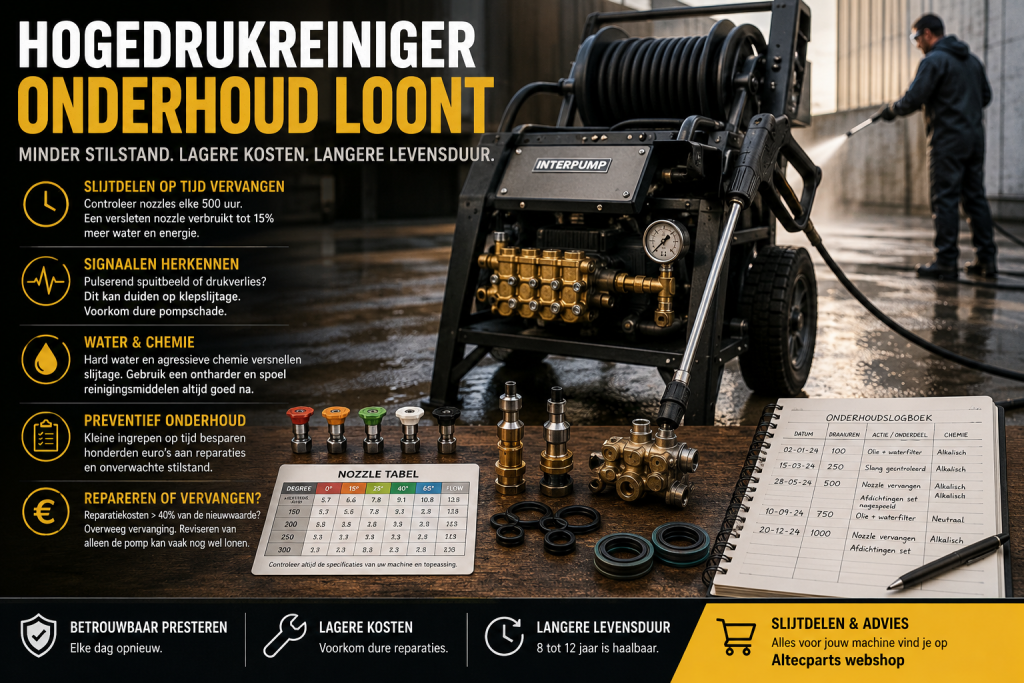
The hoses, nozzles, and seals of a pressure washer wear out faster than most people think. After approximately 500 operating hours, it's wise to check the nozzle for wear, as a worn one consumes up to 15 percent more water and energy. Specialized suppliers such as the Altecparts webshop offer nozzle tables that allow you to precisely determine which type suits your machine and application.
Recognizing wear parts before it's too late
The high-pressure pump is the heart of every machine, and its pistons and valves are the parts that wear out first. A typical sign of pump valve wear is a pulsating spray pattern or a noticeable loss of pressure at constant flow. Ignoring these symptoms risks damage to the pump head itself, and that repair can quickly cost between 400 and 800 euros.
High-pressure hoses deserve at least as much attention. A hose that becomes frayed on the outside or shows small blisters is about to fail. For professional use in a car wash or construction site, replacement after two to three years is a sensible guideline, regardless of how the hose looks visually.
Water, chemicals, and their impact on lifespan
The type of water you use has more impact than you expect. Hard water with a lime concentration above 20 German hardness degrees significantly accelerates the wear of valves and seals. In regions like Flevoland and parts of North Brabant, where tap water is relatively hard, it pays to install a water softener upstream.
Cleaning agents also play a role in the lifespan of internal components. Alkaline foam products, widely used for removing grease and oil, can damage rubber seals if not rinsed properly. Manufacturers such as Interpump and Cat Pumps specify in their manuals which chemical pH values their pumps can tolerate, typically between 5 and 9.
For those who regularly work with aggressive chemicals, it's smart to keep sealing kits of the correct material in stock. Viton seals are resistant to harsher agents than standard NBR rubber. Such kits are available per pump type via the Altecparts webshop, including technical advice on material compatibility.
Preventive maintenance as an investment that pays for itself
A maintenance schedule sounds administrative, but it saves hundreds of euros annually. For an average cleaning company with three pressure washers, unplanned repair costs without planning typically amount to over 2,000 euros per year, while preventive replacement of wear parts remains around 600 euros. This difference only increases as the machinery ages and operating hours increase.
The schedule doesn't have to be complicated. After every 100 operating hours, check the oil level and water filter, and after 500 hours, replace the nozzle and seals. Record every intervention in a logbook so you can recognize patterns and order wear parts in time from a specialist in high-pressure technology.
When repairing is no longer worthwhile
There comes a point when replacing parts becomes more expensive than buying a new device. As a rule of thumb, repair costs exceeding 40 percent of the new value constitute the tipping point. A pressure washer costing 3,000 euros that needs 1,200 euros in repairs is precisely at that limit.
However, that calculation is not always black and white. A professional machine with an Interpump pump often has a frame and motor construction that can last for decades. In such a case, it is more economical to have only the pump overhauled, something that specialized companies in places like Herveld can do within one working day while the rest of the machine remains in use.
Anyone who takes their equipment seriously keeps a simple logbook of operating hours, replaced parts, and chemicals used. With this information at hand, you can specifically look up parts via a webshop for high-pressure technology and prevent a small problem from escalating into costly downtime. That not only saves money but also the frustration of a machine that stops working at precisely the wrong moment.